Wednesday, August 22, 2012

Has the Rally Begun for Gold, Silver and the Miners?


The 'Helicopter Economics Investing Guide' is meant to help educate people on how to make profitable investing choices in the current economic environment. We have coined this term to describe the current monetary and fiscal policies of the U.S. government, which involve unprecedented money printing. This is the official blog of the New York Investing meetup.

Gold, silver and their mining stocks have been meandering sideways for months, but it looks like the early stage of a rally has begun. Confirmation of a sustainable uptrend hasn't taken place yet and that is the point when it's a good idea to be fully invested. There is enough reason to start accumulating a position however.

The technical picture for the monetary metals and their mining ETFs on the daily charts brightened considerably on Monday and Tuesday. While this was true for a number of indicators, investors should pay closest attention to the DMI (Directional Market Indicator). This flashed a buy signal for ETF GDX, which represents the senior gold and silver mining stocks. GDXJ, the junior mining stock ETF, and the silver ETF SLV were all on the verge of doing the same on Tuesday. The ETF GLD was positively positioned for a short-term rally, but will not be able to give this signal until rallying for several more days. In any move up or down in gold and silver, it would make sense for the mining stocks to move first.
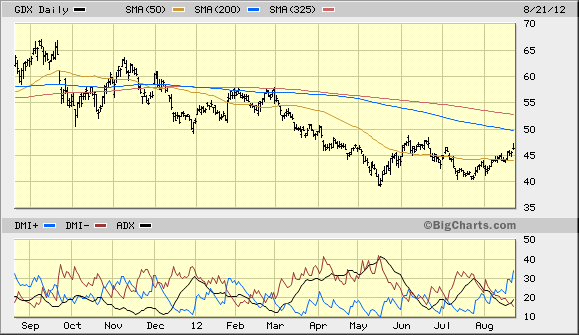


While the bullish picture isn't complete just yet on the daily charts, more work needs to be done on the weekly charts. A buy signal on these longer-term charts is the confirmation of a longer-term rally that investors would like to see. This could happen in a week or two and should be followed closely.

There is one other major missing piece for a completely bullish picture and that is the position of the moving averages. GLD, SLV, GDX and GDXJ are all in bearish patterns with the 50-day simple moving average being below the 200-day (or the 10-week is below the 40-week). The prices for all of these ETFs have moved above the 50-day and are heading for the 200-day. That resistance needs to be broken next, and then the 50-day average needs to move above the 200-day. This will take some time for the miners, but possibly very little time for GLD. Probably before this moving average cross takes place, prices will rise above the 65-week (or 325-day) moving averages. Moving and staying above this level should be interpreted as the rally is here to stay and that everything else will fall into place.

The major risk to an ongoing rally in the precious metal sector is the situation in Europe. A major drop in the euro could be bearish because this will cause the U.S. dollar to rise and gold and the dollar usually move in opposite directions. There are times however when they both move together. The risk to the global financial system caused by a euro breakdown could be one of them.

In the very long term, both gold and silver are in secular bull markets that began in 2001. This secular bull is likely to last around 20 years  and could be with us for up to 25. The biggest part of the move in secular bulls is usually in the last few years. We are still in the early stages of this rally.


Disclosure: Accumulating long positions in gold, silver and mining ETFs. 


Daryl Montgomery
Author: "Inflation Investing - A Guide for the 2010s"
Organizer, New York Investing meetup
http://investing.meetup.com/21

This posting is editorial opinion. There is no intention to endorse the purchase or sale of any security.

Friday, August 17, 2012

If an EU Leader Says It, Don't Believe It


The 'Helicopter Economics Investing Guide' is meant to help educate people on how to make profitable investing choices in the current economic environment. We have coined this term to describe the current monetary and fiscal policies of the U.S. government, which involve unprecedented money printing. This is the official blog of the New York Investing meetup.

German leader Angela Merkel revved up the markets on Thursday by saying once again that she and the other EU leaders would do everything possible to save the euro. If traders realized how reliable previous official statements concerning the Eurozone debt crisis have been, markets would have experienced a major selloff.

When the debt crisis first appeared in Greece, Merkel said there would be no bailout and the Greeks would have to solve their own financial problems. ECB President Trichet made it clear that Greece wouldn't receive any special treatment. It wasn't long before they both backtracked on their public statements. On April 11, 2010, a €30 billion bailout was agreed to and this was raised to €45 billion on April 16th. By May 2nd, a total package of  €110 billion had been arranged. This amount was meant to fix Greece's debt problems once and for all. The Washington Post reported that IMF director, Dominique Strauss Kahn, and EU Commissioner Olli Rehn stated, "the plan would lead to a more dynamic  economy that will deliver the growth, jobs, and prosperity that Greece needs in the future". If there were a worst-forecasting-prediction-of-all-time award, both Strauss-Kahn and Rehn could be potential winners.

Not only did the Greek economy not prosper, but it went into a tailspin. Other claims made by the EU proved to be equally absurd as well.  As reported by BBC News, the Greek debt to GDP ratio was supposed to rise from 115% at the time of the bailout to 149% in 2013, when it would then fall. Instead it rose to 165% in 2011. Greece's budget deficit was expected to be down to 3% of GDP (the EU target rate that all members states are obligated to meet). If Greece is lucky, it's deficit will only be 7.3% of GDP this year. It is expected to rise again in 2013 however to 8.4%. So much for that.

Even though Greece missed the EU and IMF's projected targets by a mile, this was only possible because a much bigger bailout took place in 2012. Greece received an additional €130 billion  and got to effectively write off almost 75% of its government debt held by private bondholders (the ECB and IMF were exempt from the write down). Certainly Greece must be better off after €240 billion in bailouts and writing off a big part of its debt, isn't it? Well, no it isn't. Before the first bailout in 2010, Greece had around €300 billion in government debt. Just released figures indicate in now has €303 billion in debt. While debt is no lower, GDP has collapsed, falling over 9% in 2011 alone and currently on target for an over 6% drop this year. Unemployment has skyrocketed with the someone under 25 being more likely not to have a job than to be working. By almost any criteria you wish to chose, the EU, IMF and ECB program has been a complete failure.

Now the EU and its partners are preparing to bailout Spain. Already a €100 billion loan has been committed for Spanish banks. This doesn't include any funds to bailout the government. How bad is the situation in Spain?  Well, Reuters has reported that one of Spain's regional mayor robbed a number of supermarkets last week and distributed the stolen food to the poor. As a member of  a regional parliament, he is immune from prosecution. Government stealing from those that have is of course nothing new, but apparently in Spain there's no attempt to hide it.

It looks like Spain will be asking for a full-fledged bailout soon. The EU will then directly take over its finances.  The total bailout could easily involve a trillion euros or more, unless some EU country stops it after realizing the damage this is going to cause the EU itself, let alone Spain. The long-term implications are likely to be quite ugly for both.

Disclosure: None

Daryl Montgomery
Author: "Inflation Investing - A Guide for the 2010s"
Organizer, New York Investing meetup
http://investing.meetup.com/21

This posting is editorial opinion. There is no intention to endorse the purchase or sale of any security.

Friday, August 10, 2012

How Much Stimulus Will Be Done by China, the EU and UK?


The 'Helicopter Economics Investing Guide' is meant to help educate people on how to make profitable investing choices in the current economic environment. We have coined this term to describe the current monetary and fiscal policies of the U.S. government, which involve unprecedented money printing. This is the official blog of the New York Investing meetup.

Much weaker than expected trade data out of China on Friday indicates more economic stimulus will be forthcoming there soon.  Even bigger stimulus is expected from the ECB as it revs up the printing presses to bail out Spain and Italy (unless Germany stops it of course). According to a recent released report, the recessionary economy in the UK may need massive doses of quantitative easing to recover.

Exports in China rose by only 1% year over year in July and this was well below forecasts of an increase of 8.6%. Imports were up 4.7%. For a country that has an export-based economy like China does, this is a serious problem. Like the U.S., Europe and Japan, China engaged in a massive amount of stimulus during the Credit Crisis in 2008/2009, spending $586 billion or 14 percent of its GDP in addition to cutting interest rates and lowering banking reserves.  This led to a big expansion of local government debt, a major housing bubble that has yet to burst and consumer inflation. Apparently, there are unfortunate side effects when governments apply a lot of economic stimulus (notice you rarely read about them in the mainstream media).
This time around, China has already cut interest rates twice and reserve requirement ratios for banks three times since November. Its economy has slowed for the last six quarters and probably by much more than official figures indicate (China's economic numbers should be taken with a grain of salt).
China is still in spectacular shape though compared to Japan, which had a massive trade deficit in the first half of 2012. Japan has been economically troubled for 22 years and despite zero percent interest rates and an unending number of stimulus measures its economy remains in the doldrums. While all the stimulus hasn't solved Japan's economic problems, it has led to a debt to GDP ratio of over 200% (worse than Greece's).
One reason China's exports are doing so poorly is the weakening economy in Europe. On Thursday, the ECB cut its growth forecasts and is now predicting the eurozone economy will contract by 0.3% in 2012.  They are still hopeful of slight growth in 2013 however. Maybe they think it will come from all the money they plan on printing to bail out Spain and Italy. The Eurozone is basically tapped out from all the bailouts it has already done in Greece, Portugal, and Ireland (Cyprus and banks in Spain are now on the list as well). Greece needs a third bailout and is struggling to make it through the month until it receives its next welfare payment in September. The situation there is potentially explosive. The IMF has stated Ireland will need another bailout by next spring.
When ECB President Draghi said on July 9th that the central bank will take any measures within its mandate to save the euro, the inevitable conclusion was that he was willing to engage in massive money printing. The amount of money needed for the huge bailouts that Spain and Italy would require simply doesn't exist so it has to be created out of thin air. The Draghi proposal is for the ECB to buy bonds, but the ECB has already tried buying bonds under the SMP program.  The moment the buying stopped, interest rates shot right back up. This approach is costly and only effective in the very short term — a typical government program. It won't prevent the Eurozone's failure, it will merely delay it and make it worse when it happens.
The UK is not part of the Eurozone, but its economy is also contracting. Citigroup economists have stated that the UK will need to print an additional £500 billion and lower interest rates to 0.25% to prevent continued stagnation. Apparently, they don't think there are serious risks if this approach is taken. Neither did the Weimar Germans in the early 1920s, the Zimbabweans in the 2000s, the Chinese in the 1940s, the Brazilians for most of the 20th century, the Yugoslavians in the 1990s or the Hungarians in 1946. In fact, countries that create hyperinflation always claim the risks of money printing are minimal before it takes place. And there are usually a large number of top economists that support this view.  

There are serious structural problems in the major economies today. The usual Keynesian quick fixes that have been applied since World War II no longer seem to work, nor will they. These have led to a world drowning in debt and all debtors eventually reach their borrowing limit. When this happens with countries, they then try to print their way to prosperity. History makes it quite clear that this doesn't work either. 

Disclosure: None

Daryl Montgomery
Author: "Inflation Investing - A Guide for the 2010s"
Organizer, New York Investing meetup
http://investing.meetup.com/21

This posting is editorial opinion. There is no intention to endorse the purchase or sale of any security.

Friday, August 3, 2012

July Jobs Report Shows U.S. Economic Statistics Are a Joke


The 'Helicopter Economics Investing Guide' is meant to help educate people on how to make profitable investing choices in the current economic environment. We have coined this term to describe the current monetary and fiscal policies of the U.S. government, which involve unprecedented money printing. This is the official blog of the New York Investing meetup.

According to the Labor Department, the U.S. added 163,000 jobs in July. Also according to the Labor Department, the U.S. lost 195,000 jobs in July. So the U.S. economy is either doing OK or it's falling apart big time. Or maybe something between the two is happening. Confused? You should be.

Two separate surveys are used for the employment report. In one, they ask businesses about the amount of hiring they've done in the previous month and in the other the ask people whether or not they have a job. The amount of jobs created for the month is determined by the business survey and the unemployment rate from the survey of households. As more than one article on the July employment report pointed out today, "economists say the business survey is more reliable". So if you think you're unemployed, but an economist says you have a job, the economist is right.

The unemployment rate ticked up to 8.3% according to the household data.  The two surveys have frequently not seemed to match in the past with minimal job gains resulting in drops in the unemployment rate. The Labor Department explained that this occurred because millions of people have left the U.S. labor force since the "recovery" began in 2009 (150,000 more left in July). Even though these people are unemployed, they are not counted as unemployed and this makes the unemployment rate look better. Why millions of people would stop looking for work during a "recovery" has never been answered. Usually, this type of behavior takes place during depressions.

The Labor Department did not discuss the massive discrepancy between its two employment surveys in its press release. Instead it gave a rosy assessment of all the jobs created last month. This included 25,000 new jobs in manufacturing, even though the recent ISM Manufacturing report (a private survey) indicated U.S. manufacturing activity shrank last month.  So an industry that is losing business is hiring lots of new workers. That certainly makes a lot of sense all right.

One possible explanation for the discrepancy was that "inappropriate" statistical adjustments were made to the numbers in the business survey. While one should never rule out gross incompetence when discussing the output of the government statistical offices, a more cynical person might think that there was a purposeful effort to produce better numbers than actually exist because it's an election year. After all, those pesky downward revisions months later never get any notice from the press and the ugly truth can always be told later when no one is paying attention (and after they've voted).

Disclosure: None

Daryl Montgomery
Author: "Inflation Investing - A Guide for the 2010s"
Organizer, New York Investing meetup
http://investing.meetup.com/21

This posting is editorial opinion. There is no intention to endorse the purchase or sale of any security.

Thursday, August 2, 2012

Central Banks Sucker the Market


The 'Helicopter Economics Investing Guide' is meant to help educate people on how to make profitable investing choices in the current economic environment. We have coined this term to describe the current monetary and fiscal policies of the U.S. government, which involve unprecedented money printing. This is the official blog of the New York Investing meetup.

Three major central banks met on August 1st and 2nd and none of them took any decisive action. Markets in the U.S. and Europe have been rallying since late June on expected policy easing they've been promised by reports in the mainstream media. So far, empty talk is all the central banks have delivered.

Traders had high expectations for the Fed's monthly meeting on July 31st and August 1st. A week previously, news hit the wires (only a few moments before Apple's disastrous earnings were announced) that the Fed was definitely going to do some easing at this week's meeting. The source was the Wall Street Journal and they followed up with a front page article the next day. And what did the Fed do?  Nothing, zilch, nada. So much for the Wall Street Journal being a reliable source of investing information.

For the previous meeting in June, Goldman Sachs claimed the Fed was going to be doing quantitative easing (or maybe some other form of easing, but you would have to have read the entire coverage to find that out). What happened when QE wasn't forthcoming? The market hypsters came out of the woodwork with assurances that QE3 would be announced at the July/August meeting. Now that that hasn't happened either, we are hearing "just wait until September". You might as well wait for Godot. The only way the Fed will be doing QE before the election is if the financial crisis in the Europe gets out of hand. This will not stimulate the economy, but prevent a total collapse of the stock market (not a drop, but a total collapse).

The Bank of England and the ECB also met today. No rate changes from either of them (unlike the U.S. and Japan both have rates slightly above zero and they could lower them). The Bank of England is already doing QE2 and has been doing so since the fall of 2011. The UK is in a recession and QE has not stopped its economic decline.

Mario Draghi, the ECB chair and one of the biggest windbags to ever run a central bank, held a press conference after his meeting. He said that the ECB would undertake "outright" open market operations and would be using non-standard policy measures. Bonds rallied on the news. Unfortunately, only minutes later, Draghi was forced to backtrack on his boisterous pronouncements. He admitted that he was only providing "guidance" of what was going to occur in the future and details wouldn't be available for weeks. Draghi continued that even if the ECB was ready to act now, it would not have the grounds to do so. Someone should give that man a bagpipe.

How long the markets will continue to fall for promises of stimulus that never comes remains to be seen. Whatever happens, there is no reason be confident that things will be getting better. If the Fed could fix the U.S. economy, it would already have done so. If the ECB could solve Europe's debt crisis, it also would have already done so. Doing more of the same is not going to work, so it's not worth waiting for cental bank action as is. Eventually, the markets will figure this out.

Disclosure: None

Daryl Montgomery
Author: "Inflation Investing - A Guide for the 2010s"
Organizer, New York Investing meetup
http://investing.meetup.com/21

This posting is editorial opinion. There is no intention to endorse the purchase or sale of any security.

Friday, July 27, 2012

Why Quantitative Easing Won't Happen Now


The 'Helicopter Economics Investing Guide' is meant to help educate people on how to make profitable investing choices in the current economic environment. We have coined this term to describe the current monetary and fiscal policies of the U.S. government, which involve unprecedented money printing. This is the official blog of the New York Investing meetup.

Quantitative easing is off the table for the Fed at the moment because of Friday's GDP report. According to the Commerce Department U.S. second quarter GDP growth was 1.5%, which is mediocre, but not bad enough to justify another round of money printing stimulus.

The stock market has been juiced up on a number of occasions since June on rumors of impending QE3.  There is always connected to phrase like "the Fed will do more to help the economy." The mainstream press never raises the question of why does the Fed need to do more to help the economy. If its program worked, the economy should have recovered. If they don't, doing more of the same thing isn't likely to accomplish much. A need for a third round of QE certainly implies that the first two weren't effective — at least in creating economic growth.  Could it be that printing money out of thin air doesn't really create lasting wealth?

All the U.S. fans of quantitative easing should look across the pond at what is taking place in the UK. Its second round of QE was started last October. Yet, Britain has fallen into and remains in recession. It doesn't look like it will exit the recession by the end of the year either. So much for QE being a panacea for saving an economy.

The best case for the ineffectiveness of QE though comes from Japan. Japan has maintained a zero interest rate policy since 1999 (the U.S. had done so since 2008). After ten years of economic decline and malaise Japan began implementing quantitative easing in the early 2000s. The ten years that followed were also a period of economic decline and malaise. The Japanese stock market peaked in 1989 and over twenty years later it is still down more than 75% from its high (investors who fought the Bank of Japan are glad that they did). The various stimulus programs raised stock prices temporarily, but they eventually fell to lower lows.

The stimulus bag of tools that central banks use is meant to be effective when there is a cyclical downturn in the economy. However, they will not work if the problem is structural — and that is exactly what Japan has been dealing with since 1990 and Europe and America are dealing with today (and probably since 2000). We are at the end of the Keynesian era, where credit can no longer be extended to greater levels without creating a subsequent collapse and the economy can't grow without continual stimulus from the central banks and massive government deficits. This is sharply evident in the case of Greece and Spain at the moment, but it is just as true in the U.S., UK and Japan.

The Fed can't just cavalierly decide to engage in more QE as is. It will need to do so if there is a major financial incident in the EU and it can't waste its bullets. It is inevitable that there will be such a crisis, and the Fed knows it. Mario Draghi's assertion on Thursday that the ECB will do everything possible to save the euro was nothing but meaningless bravado. The crisis in Europe has been going on for over two years now and despite numerous bailouts and half a dozen support schemes it keeps getting worse. During the entire time, the powers that be in the EU have said that they will do everything to save the euro. Sometimes "everything" isn't enough. 

The Fed also has the problem of looking political if it acts before the election. While it is true that the Fed has acted before elections in the past, it actions weren't being closely scrutinized back then. Nor were its policies politically controversial. The House of Representatives just passed the Federal Reserve Transparency Act of 2012 by 327-98. This legislation would produce a full audit of the Fed. While it might not pass the Senate this time around, eventually it will.

While the Fed will almost certainly be doing quantitative easing again, but it won't happen until either  the problems in Europe become a full-fledge global credit crisis or the U.S. economy is in an obvious recession. In either case, it will not be something to cheer about. 

Disclosure: None

Daryl Montgomery
Author: "Inflation Investing - A Guide for the 2010s"
Organizer, New York Investing meetup
http://investing.meetup.com/21

This posting is editorial opinion. There is no intention to endorse the purchase or sale of any security.

Friday, July 20, 2012

The EU May Have Reached Its Bailout Limit


The 'Helicopter Economics Investing Guide' is meant to help educate people on how to make profitable investing choices in the current economic environment. We have coined this term to describe the current monetary and fiscal policies of the U.S. government, which involve unprecedented money printing. This is the official blog of the New York Investing meetup.

Today, yields on Spanish 10-year sovereigns tested their yearly high yield of 7.28%, while Italian rates reached 6.16%. This was after funds for the Spanish bank bailout were approved by the EU, although the money won't be going directly to the banks. Earlier in the week, the IMF admitted that  the only solution to Europe's debt woes was to run the printing presses at full speed.

The situation in Spain is ugly and getting worse. Unemployment is almost 25% there and the country is in a recession. The Spanish economy is dependent on public spending and building empty houses that no one buys. The government has recently announced severe spending cuts and higher taxes, both of which will lower future growth. Yet, until today Spain was forecasting GDP growth of 0.2% for next year. It now thinks that GDP will decline by 0.5% in 2013. This is not just an optimistic scenario; it's a Harry Potter fantasy scenario. As is the case with Greece, Spanish economic and financial numbers cannot be trusted. Greece in the early stages of its bailout also produced optimistic projections of how easily and quickly everything would be fixed. Instead, its financial problems escalated out of control.  The same outcome should be expected in Spain.

Bailed-out Bankia is a good example of the how reliable the books are for Spanish banks. Bankia claimed to have earned a 300 million in profits in 2011, but in late May revised that to a €3 billion loss. Now Spain is in line for a €100 billion bailout from the EU, although it has claimed that it needs less. Based on how Bankia did its accounting, Spanish banks are likely to need more, maybe ten times more than that amount. This does not include money for bailing out the bankrupt Spanish government.  

Originally, the EU planned on providing the bank bailout money (structured as a long-term loan) directly  to Spain, who would in turn distribute it internally. When this caused Spain's sovereign debt rating to be downgraded, creating greater fiscal problems for the struggling government, the EU then decided to route the loan directly to the banks. Yesterday, the German parliament refused to go along. They were only willing to approve a loan directly to the Spain itself. It wasn't easy to get even that passed. Twenty-two members of Angela Merkel's coalition voted against it. The leader of the Free-Democrats described the bailout as "a bottomless pit". It doesn't look like German legislators have an appetite for any further bailouts and this is bad news for Spain and Italy as well.  

The IMF has an idea of what to do instead, but its solution could hardly be described as constructive. In a report issued on Wednesday, the organization essentially advised the EU to engage in every type of money printing possible, do a lot of it, and to start doing it immediately. The ECB has already expanded its balance sheet by more than the U.S. has and it hasn't solved the EU's problems so far. Massive money printing as suggested by the IMF would debase the euro significantly. So, in order to save the currency union, the currency it issues must be destroyed. Somehow, there seems to be a logic flaw in this line of reasoning (sort of like, a debt crisis can be solved by incurring more debt).

The bailout news today was disastrous for Spain and Italy. The Spanish IBEX index was down 5.79% dislocations  — a mini-crash and the worst drop in the two years. The Italian market was down 4.4%. The euro hit a new yearly low. The ETF FXE traded down to 120.78. This is below its bottom during the Credit Crisis, but still above the 2010 low made when the debt crisis first appeared. As the situation continues to unravel, more selling should be expected.


Disclosure: None
Daryl Montgomery
Author: "Inflation Investing - A Guide for the 2010s"
Organizer, New York Investing meetup
http://investing.meetup.com/21

This posting is editorial opinion. There is no intention to endorse the purchase or sale of any security.